Green Buildings: Beyond Certifications and Technologies
Net Zero, Green Buildings & the Reality Check We Avoid
These days, it has become fashionable to talk about net zero, decarbonisation, green buildings, and sustainability. We proudly showcase certifications, dashboards, and presentations—often backed by investments running into lakhs and crores.
But if we are being honest, are we truly serious about sustainability?
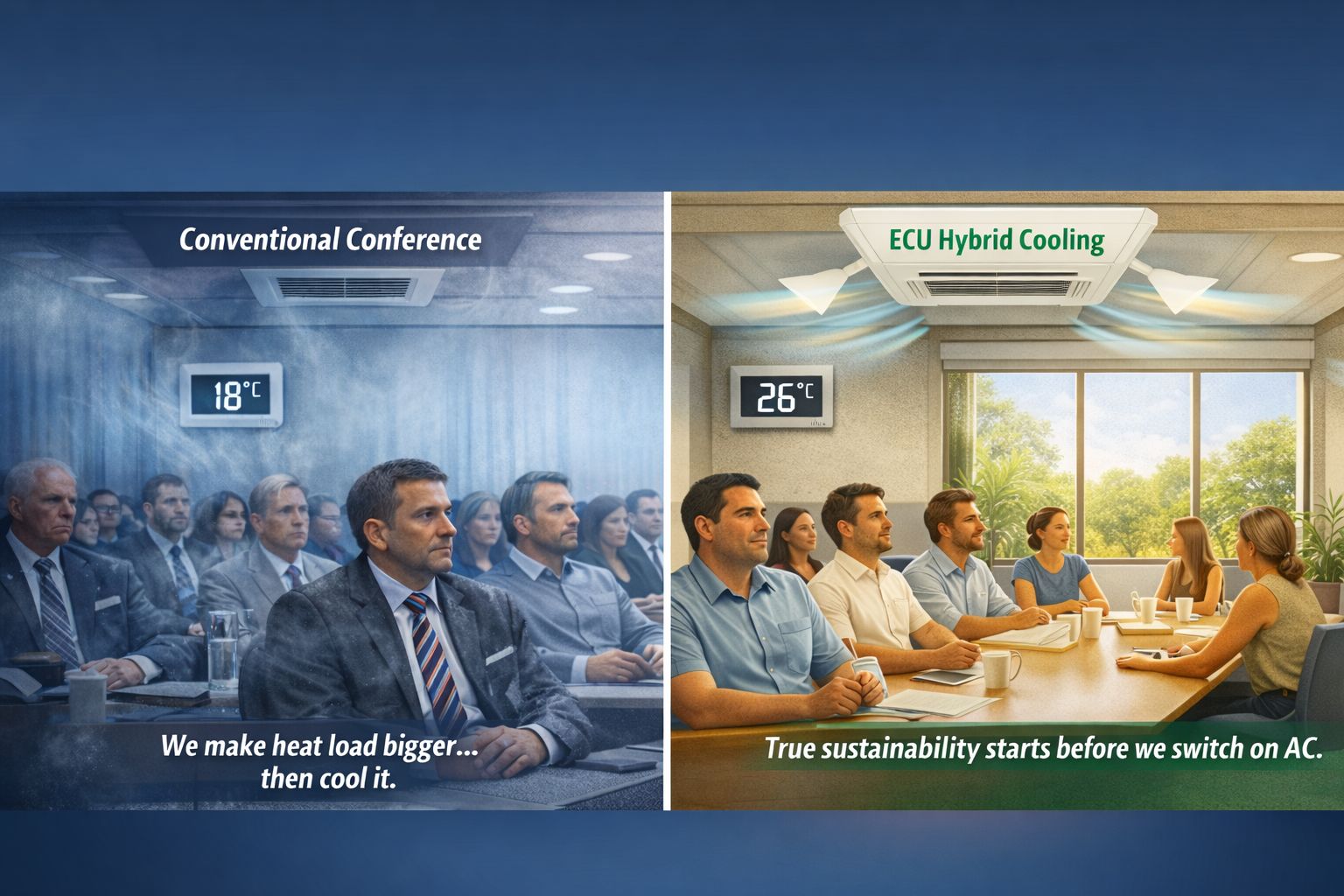
If we were, then our seminar halls, conference rooms, and office spaces wouldn’t be full of people wrapped in suits, boots, ties, and multi-layered clothing—in all seasons. These dress codes were designed for cold climates or western aesthetics, not for tropical or subtropical conditions like ours.
What do we do instead?
We increase the heat load through heavy clothing. Then lower the AC setpoint to compensate. And finally, we call the building green. This is a contradiction we rarely acknowledge.
True sustainability is not only about installing efficient chillers, solar panels, or chasing certifications. It starts with human behavior and design intent.
A few uncomfortable but necessary questions:
- Why not promote climate-appropriate dressing instead of freezing indoor spaces?
- Why default to air-conditioning, when alternatives like ECUs, radiant cooling, air movement, adaptive comfort, and mixed-mode ventilation can deliver comfort at a fraction of the energy?
- Why design for uniform 22°C comfort, ignoring adaptive thermal comfort models?
- Why talk about operational carbon while ignoring avoidable cooling demand?
Real sustainability is about:
- Reducing demand before adding capacity
- Designing buildings and operations around local climate and culture
- Accepting that comfort does not mean “cold”
- Aligning people, policies, and performance, not just equipment.
Until we address these basics, net zero risks becoming more of a marketing narrative than a meaningful movement.
Green buildings are not just made by technologies. They are made by choices, habits, and intent.
Food for thought.